
Remember when “AI” meant chatbots that could write fun poems? That era is already fading. As the first month of 2026 comes to a close, the tech industry is coalescing around a single powerful theme: “Agency” .
The days of treating AI as a passive “oracle” and just chatting are coming to an end. The new standard is AI that behaves like a “coworker” : planning, using tools, and interacting with the physical world.
The Rise of Agentic AI
So what is an “agent”? Unlike standard LLMs that only predict the next word, an agent is a system designed to “perceive, reason, plan, and act.”
Agentic AI refers to AI systems that can pursue complex goals under limited human supervision. It breaks down high-level instructions like “Fix this bug” into a series of steps, uses tools (terminal, browser), and iterates based on feedback.
The agent loop structure
To understand the difference, look at the workflow. A chatbot is a linear “input -> output” structure, while an agent has a loop structure.
graph LR User[User goal] —> Perception subgraph Agent Loop Perception[Perception] —> Planning[Planning] Planning —> Action[Action / Tool Use] Action —> Environment[Environment] Environment —> Observation[Observation / Feedback] Observation —> Perception end Observation —> Result[Result]
Chatbots vs agents
| Feature | Generative AI (chatbot) | Agentic AI (coworker) |
|---|---|---|
| Role | Assistant / oracle | Collaborator worker |
| Interaction | Turn-based chat | Goal-driven triggers |
| Capability | Text/code generation | End-to-end execution |
| Tools | None (or simple plugins) | Browser, terminal, API |
| Autonomy | Low (waits for prompts) | High (self-correcting) |
Use cases in 2026
Today, effective adoption is underway in areas like the following:
- Autonomous coding : Not just storing code, but agents that read issues, reproduce bugs, fix them, and deploy.
- Enterprise operations : Supply chain agents that automatically reorder inventory when predictive models detect shortages.
Agent adoption roadmap
Step 1: Audit
Identify decision points in existing workflows
Step 2: Tool selection
Evaluate LangChain or Microsoft Semantic Kernel
Step 3: POC
Agentize one specific task (e.g., first-line customer support)
Step 4: Monitor and improve
Build a Human-on-the-loop setup and monitor metrics
Physical Intelligence
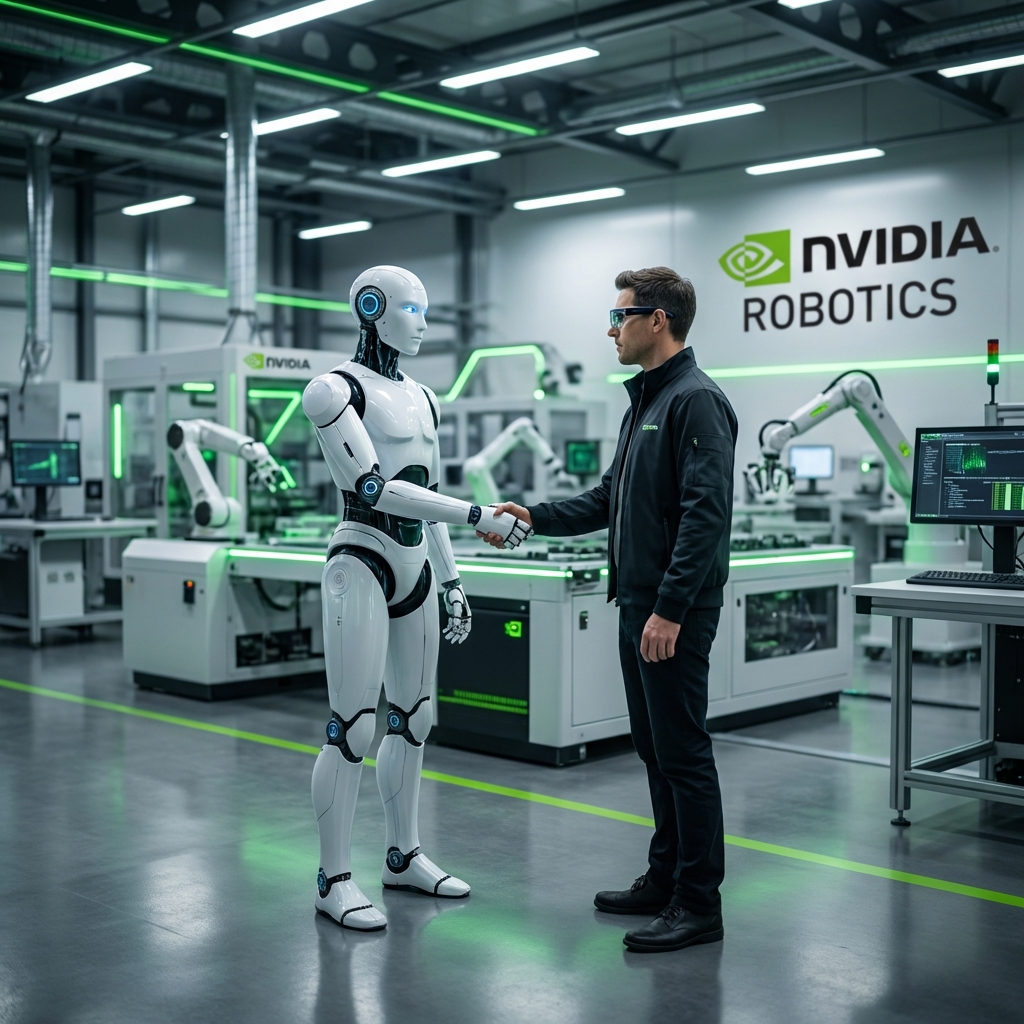
If Agentic AI is the “brain,” Physical Intelligence is the “body.” What dominated CES 2026 was not new screens but moving machines.
The turning point was NVIDIA’s keynote. The focus was not just faster chips, but AI that understands physics, gravity, and spatial relationships, namely “World Models” .
CES 2026 highlights
- NVIDIA Cosmos : A foundation model for physical-world simulation.
- Project GR00T : A general-purpose foundation model for humanoid robot learning.
[!NOTE] The boundary between digital and physical is closing rapidly. Robots are no longer hard-coded; they learn through simulation (Physical AI) and are deployed in the real world.
The governance gap
High autonomy comes with major legal responsibility. If an agent deletes a production database or a warehouse robot drops a package, who is accountable?
This “governance gap” is the hot topic of 2026. The concept of “Human-in-the-loop” is evolving into “Human-on-the-loop” . We are shifting from operators to supervisors.
| Concept | Human-in-the-loop (legacy) | Human-on-the-loop (2026) |
|---|---|---|
| Role | Approver / operator | Supervisor / auditor |
| Intervention frequency | Every critical decision | Only when anomalies occur |
| Scalability | Low (humans are the bottleneck) | High (one person manages many agents) |
| Accountability | The human who made the final decision | System designers and operations managers |
Conclusion
2026 is the year of the “Doer” . The novelty of “talking” to computers has faded. Now we are building computers that work alongside us.
For developers and businesses, the message is clear: “Stop building chatbots and start building agents.”




⚠️ コメントのルール
※違反コメントはAIおよび管理者により予告なく削除されます
まだコメントがありません。最初のコメントを投稿しましょう!